How to Choose a Crypto Mining Pool: 9 Checks That Actually Matter
A mining pool is only as good as the fine print behind its headline fee. At today's difficulty of 132.76 T, one 500 TH/s machine produces about 0.000224 BTC per day — $19.00 of gross income — so a single percentage point of fee on the block-reward component is worth roughly $0.19 a day, or about $5.70 a month, per rig. These nine checks take an hour with a calculator and a browser, and they tell you exactly where that money goes.

Key takeaways
- Network output is fixed: 3.125 BTC per block × 144 blocks = 450 BTC a day, about $38.1 million at a BTC price of $84,692. Every pool is splitting the same pie.
- PPS+ is not a flat 6% haircut. The listed rate is 4% on the PPS-settled block reward and 2% on the transaction-fee component — different slices of the same payout.
- A 5 PH/s setup at 20 J/TH draws 100 kW, which is 2,400 kWh a day and roughly $144 of power at $0.06/kWh against $189.97 of gross daily income.
- Cadence is cash flow: hourly settlement at 1 PH/s returns about 0.0000187 BTC per hour, near $1.58, instead of a reward that depends on when the pool finds a block.
Why the numbers move before you change anything
Bitcoin retargets difficulty every 2,016 blocks so that blocks keep arriving about every ten minutes regardless of how much hardware joins the network. Today the network runs at a difficulty of 132.76 T and a total hashrate of roughly 1,003 EH/s, which means the whole industry shares 450 BTC of daily subsidy plus whatever transaction fees blocks happen to carry.
That fixed output is the reason pool selection matters more than most miners expect. Your gross daily income is a simple ratio: your hashrate divided by network hashrate, multiplied by 450 BTC, plus your slice of fees. At 1,003 EH/s, one terahash per second produces about 0.0000004486 BTC per day — 4.49 satoshi-ish fractions of a coin that look trivial per unit and add up fast across a rack.
The next difficulty adjustment is estimated at −2.12%, which would lift per-terahash income slightly if it lands as predicted. That estimate moves daily, so treat any pool comparison as a snapshot rather than a fixture.
What actually changes your payout
Two settings dominate. The first is the payment method, because it decides who carries pool-luck risk. The second is settlement cadence, because it decides when the money shows up. Everything else — interface, mobile app, coin list — is convenience layered on top of those two.
The table below puts both into numbers you can compare against your own electricity contract. It uses today's difficulty, the current BTC price, and a reference power cost of $0.06/kWh for machines running at 20 J/TH.
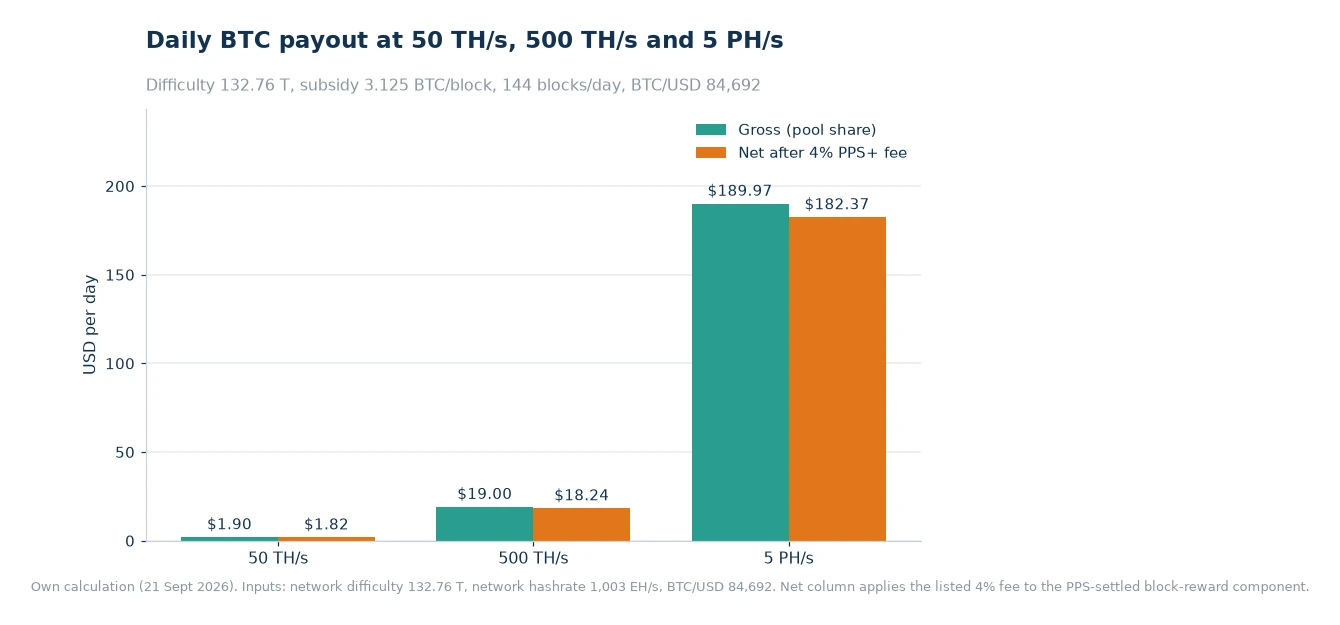
| Hashrate | BTC per day | Gross USD | After the listed 4% block-reward fee | Electricity per day |
|---|---|---|---|---|
| 50 TH/s | 0.0000224 | $1.90 | $1.82 | $1.44 |
| 500 TH/s | 0.0002243 | $19.00 | $18.24 | $14.40 |
| 5 PH/s | 0.0022430 | $189.97 | $182.37 | $144.00 |
Read the first and last columns together and the economics get blunt. A single 50 TH/s machine clears about $0.38 a day after a 20 J/TH power bill and the fee on the block-reward component. A 5 PH/s farm clears roughly $38 a day. Same protocol, same pool, completely different business.
The nine checks that actually matter
- What the fee applies to. A 4% charge that hits only the block-reward component is not the same as 4% of everything. Ask which components carry which listed rate before you compare two pools.[1]
- Payment method and who absorbs luck. PPS+ pays per valid share against current difficulty, so the pool carries pool-luck and orphan risk. PPLNS merges block rewards and transaction fees into one distribution measured across the last five difficulty rounds, and hands that variance back to you.
- Settlement cadence. Hourly payment is a materially different product from a distribution that arrives only when the pool finds a block. For a farm paying fixed power bills, the timing difference is working capital.[2]
- Where the coins land. An integrated multi-currency wallet with zero-fee mining payouts removes an exchange hop and the withdrawal fees that come with it. Check both the payout rail and the withdrawal path.
- Supported chains and merged mining. A pool covering BTC, BCH, LTC/DOGE, KAS, ZEC, HNS, CKB and ETC — over twenty assets in the case of ViaBTC Crypto Mining — lets you move a machine to the chain that currently pays best without changing operators.
- Latency and node coverage. Stale and rejected shares are silently lost income. Globally distributed nodes shorten the round trip between your miner and the pool.
- Uptime and orphan handling. Ask what fraction of found blocks get orphaned and how the pool's payment method treats them. On PPS+ the answer is not your problem; on PPLNS it is.
- Per-worker visibility. A pool whose dashboard only shows account totals hides dying hashboards. Per-worker hashrate history and mobile alerts catch a failed fan or a downed PSU in hours rather than weeks.
- The supporting tools. A profit calculator that includes merged-mining output and a live miner profitability ranking let you sanity-check a purchase before you buy the hardware, not after.
Worked example: 5 PH/s on a real power contract
Take a 5 PH/s farm built from 20 J/TH machines. Hashrate of 5,000 TH/s at 20 joules per terahash is 100 kW of continuous load — 2,400 kWh per day, or about $144 at $0.06/kWh. Gross income at today's difficulty is $189.97 a day, and applying the listed 4% rate to the block-reward component leaves $182.37.[3]
That is a margin of about $38 a day, or 20% of gross, before hosting, cooling and maintenance. It is also the number a pool choice can quietly eat: a hypothetical extra two percentage points of fee on the same base would cost about $3.80 a day, roughly $114 a month, on this single farm. At the small end the arithmetic is harsher — a 50 TH/s machine earns $1.90 gross, pays $1.44 for power and keeps $0.38 for the month's effort, so efficiency and electricity price decide profitability long before the fee does.
What to check once a month
Pool selection is a decision you re-make quietly every month. Four numbers cover it: current difficulty against the level where you started, your pool's share of network hashrate, your realised payout per PH/s against the calculated expectation, and your own uptime as reported per worker.
If realised income drifts more than a few percent below expectation while your hashrate is flat, look at rejected shares first, then at the pool's block luck if you are on PPLNS. Both are visible on a mining pool dashboard and both are fixable — but only if someone reads the numbers.
Frequently asked questions
Do mining pools cost anything to join?
Joining is free; the pool earns from its fee on settled payouts, which appears as a percentage of the block-reward and transaction-fee components.
Can I mine more than one coin at the same time?
Yes. Merged mining lets a machine secure a parent chain and an auxiliary chain together, and multi-coin pools support switching between chains without moving hardware.
How do I compare two pools with the same headline fee?
Compare what the fee applies to, the settlement cadence, and the payout rail. Two pools advertising 4% can differ by more than the fee itself once hourly settlement, withdrawal fees and orphan handling are counted.
Start with the fee, finish with the wallet
Work the nine checks in order and the shortlist writes itself: confirm which components carry which listed rate, confirm when payouts settle, then confirm where the coins land. Run the same hashrate through both candidates' numbers before committing a rack.
Then leave the arithmetic alone for a quarter and watch realised versus expected payout instead. Pools rarely lose customers over a fee change; they lose them when the dashboard stops matching the bank statement.
Data and sources: ViaBTC fee schedule and pricing page[1], ViaBTC fee breakdown[2] and ViaBTC profit calculator[3]; network difficulty and hashrate from public chain data, read on 21 September 2026. All earnings figures are own calculations from the difficulty, hashrate and BTC/USD price above and change as those inputs change.