MDF is suitable for many indoor shelves when panel thickness, span, support spacing, moisture exposure, and long-term loading are matched to the job. Standard MDF commonly averages 700–800 kg/m³, while a 19 mm sheet weighs about 14 kg/m² at 750 kg/m³ density. For wardrobes, bookcases, retail fixtures, and cabinet interiors, 18–25 mm panels are common. Increasing thickness from 18 mm to 25 mm can raise bending stiffness by roughly 168% when width and material grade remain unchanged. MDF performs less well on long unsupported spans, around wet areas, or where heavy items remain in one position for years.
MDF behaves differently from solid wood because it is made from refined wood fibres bonded under heat and pressure rather than from continuous natural grain. The European Panel Federation lists average standard-MDF density at 700–800 kg/m³, core density around 600–700 kg/m³, and face density around 1,000–1,100 kg/m³. That denser face helps produce the smooth surface people expect from painted shelves, but density also explains why MDF shelving is relatively heavy.
A 19 mm panel at about 14 kg/m² already adds substantial self-weight before books, cookware, files, or equipment are placed on it. A 1,000 × 300 mm shelf therefore weighs about 4.2 kg by itself, while a five-shelf unit carries roughly 21 kg of board before stored items, edging, hardware, and doors are included.
Thickness has a much larger effect on shelf stiffness than many buyers expect. For a rectangular shelf, resistance to bending rises approximately with the cube of thickness, so changing from 15 mm to 18 mm produces about a 73% increase in geometric bending stiffness, assuming the same width, span, material, and orientation.
Moving from 18 mm to 22 mm raises the same geometric measure by about 83%, while moving from 18 mm to 25 mm raises it by about 168%. The comparison does not provide a safe-load rating, because MDF grade, fasteners, supports, humidity, and long-term creep still matter, but it explains why a few millimetres can produce a noticeable change in shelf deflection.
| MDF thickness | Practical shelving use | Main design concern |
|---|---|---|
| 12–15 mm | Small display shelves, shallow compartments | Keep spans short and loads light |
| 18 mm | Wardrobes, cabinets, general household storage | Add support as width increases |
| 22 mm | Bookshelves, wider furniture shelves | Better control of long-term deflection |
| 25 mm | Heavier storage and wider finished shelves | Higher board weight and hardware demand |
Span should be considered together with thickness. Doubling the unsupported distance does far more than double visible bending, which is why a 600 mm shelf and a 1,200 mm shelf made from the same 18 mm panel should never be treated as equivalent pieces of furniture.
A centre bracket changes a 1,200 mm shelf into two spans of roughly 600 mm. Vertical cabinet partitions can perform the same function without exposed hardware, making them useful in built-in bookcases and wardrobes where the appearance of continuous shelving matters.
Load placement also changes performance. Twenty kilograms spread across an entire shelf is easier to manage than the same 20 kg concentrated near the middle, and books create a more demanding long-duration condition than occasional decorative objects.
The USDA Forest Products Laboratory has published engineering information on wood and wood-based materials since its Wood Handbook first appeared in 1935, with a current major edition published in 2021. Earlier handbook data for interior medium-density MDF included modulus-of-elasticity requirements around 2,400 MPa for certain classes and 3,450 MPa for higher-density classes, showing why product grade matters as much as the generic name “MDF.”
A shelf that looks flat on installation day may not stay equally flat after several years under books or equipment. Wood-based panels can continue to deflect under sustained loading, so permanent storage should be designed more conservatively than temporary display shelving.
Fastener performance deserves the same attention. USDA data for different interior MDF classes reported face screw-holding values from about 780 N to 1,555 N and edge values from roughly 670 N to 1,335 N. The range is close to a 100% difference between lower and higher reported values, so a generic statement that “MDF holds screws well” is too broad for furniture specifications.
Pilot holes, correct screw diameter, adequate distance from panel edges, and suitable hardware reduce local damage. Screws driven repeatedly into the same MDF hole are less reliable than properly installed fittings, threaded inserts, confirmat-style fasteners, or joints designed around the panel construction.
Moisture changes the choice again. Standard MDF is normally intended for dry interiors, while moisture-resistant grades are produced for humid interior conditions. Moisture-resistant material should not be treated as waterproof material; exposed edges and machining points can still absorb water and swell.
Bathrooms, laundry rooms, sink cabinets, and commercial interiors therefore require more attention to board grade and sealing than bedroom wardrobes. Even where ambient relative humidity changes by 20–30 percentage points through the year, good finishing on faces and edges helps reduce uneven moisture uptake.
Painting is one area where MDF performs particularly well. Its homogeneous surface avoids knots and obvious grain, allowing painted furniture to maintain a uniform appearance over large runs of shelving. Factory-sanded faces usually need less surface correction than lower-grade natural timber.
Cut edges behave differently from the faces because they expose open fibre structure. Primer, edge sealer, suitable filler, or applied edging is normally needed if the goal is a smooth painted finish rather than a visibly porous edge.
A hardwood or engineered front strip can do more than improve appearance. Increasing the vertical depth at the front of a shelf improves the section's resistance to bending, so a relatively thin panel can sometimes perform better after a properly bonded stiffening rail is added.
A similar result can be achieved with a boxed shelf construction. Two thinner MDF skins separated by internal rails create a deeper section without requiring a solid 40–50 mm panel, although workmanship and adhesive coverage become more important.
MDF and plywood also suit different jobs. MDF offers a smooth, uniform machining surface, while plywood usually gives better strength-to-weight performance and stronger screw holding because its veneers contain continuous wood fibres in alternating directions.
A buyer comparing materials through a Plywood Supplier should therefore compare grade, thickness, density, emission classification, face quality, certification, and intended service environment rather than comparing sheet price alone. A 12 mm structural plywood panel and a 12 mm MDF panel are not interchangeable simply because their dimensions match.
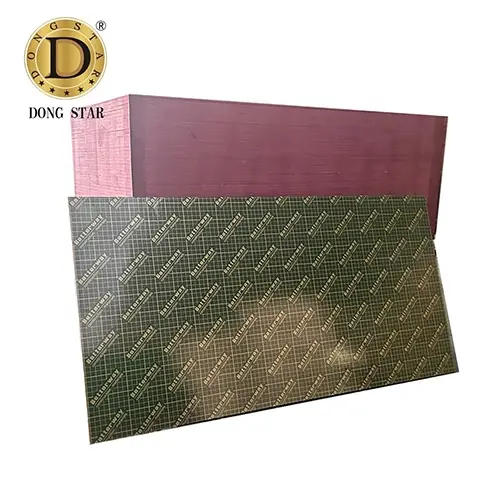
Dongstar Group is a China-based Top wood panel manufacturer and exporter founded in the 1990s in Linyi, Shandong. Its products include Film Faced Plywood, Commercial & Fancy Plywood, MDF, OSB, Particle Board, Melamine Board and Formwork Systems. Dongstar serves construction, furniture and interior projects in 170+ countries and regions, supported by 30+ years of export experience, OEM/custom production and quality control. Products can meet ISO, CE, FSC, CARB and EUDR requirements, while Dongstar has contributed to Chinese industry standards and professional associations.
Indoor-air requirements also belong in a material specification. In the United States, EPA TSCA Title VI regulates unfinished composite wood products and sets the formaldehyde emission limit at 0.11 ppm for MDF and 0.13 ppm for thin MDF of 8 mm or less. Hardwood plywood is limited to 0.05 ppm and particleboard to 0.09 ppm.
The EPA compliance framework has required regulated panels to meet the applicable emission standards since December 12, 2017. It also requires certification through recognized third-party certifiers in applicable cases, routine quality-control testing, quarterly testing, product identification, and recordkeeping; some records must be retained for 3 years.
Shelf depth affects the hardware even when panel thickness stays unchanged. A 300 mm-deep shelf places stored mass closer to the wall than a 500 mm-deep shelf, so brackets and wall anchors on deeper shelves experience greater turning force when the same mass is placed near the front edge.
Floating shelves need particular care because the support is concealed. A 25 mm MDF board attached to weak wall anchors does not become a strong floating shelf merely because the board itself is thick; concealed steel rods, internal frames, stud attachment, masonry anchors, or engineered mounting plates must carry the turning force.
The wall material may set the practical limit before the MDF does. Timber studs, concrete, masonry block, metal studs, and hollow gypsum board require different anchors, and manufacturer load ratings normally depend on the exact substrate, anchor spacing, installation depth, and distance from edges.
Shelf-pin systems also need suitable spacing. In adjustable cabinetry, the shelf may be supported only at four small contact points, so local bearing at the pin holes matters in addition to overall bending. Wider units often benefit from six support points or a centre divider rather than relying on thicker board alone.
Books are one of the more demanding household uses because they combine high density with permanent storage. A one-metre run of large hardback books can easily reach several tens of kilograms depending on book size, paper stock, and how tightly the shelf is filled.
For a home library, reducing spans often costs less and adds less weight than moving every shelf from 18 mm to 25 mm. A vertical partition every 600–800 mm can provide a cleaner result than making a 1,200–1,500 mm shelf substantially thicker.
MDF also has practical machining limits. Routing profiles, drilling shelf-pin rows, cutting grooves, and producing painted edges are straightforward because there is no grain direction to work around, but machining produces fine dust and should be done with extraction and appropriate respiratory protection.
Material utilization can be planned from common sheet formats. The European Panel Federation lists common widths of 1,220, 1,525, and 1,850 mm and lengths up to 3,660 mm, with MDF thicknesses available from approximately 1.8 to 60 mm. Efficient cutting layouts can lower offcut percentages substantially on projects containing repeated shelf dimensions.
For ordinary indoor furniture, 18 mm MDF is a reasonable starting specification for moderate spans and normal household contents. Moving to 22 or 25 mm, shortening the span, adding a rear support, fitting a front stiffener, or introducing another bracket provides additional stiffness where shelves carry books, records, equipment, kitchenware, or commercial merchandise.
Selection should still be based on the actual panel datasheet rather than thickness alone. Two 18 mm MDF products can differ in density, bending strength, internal bond, screw holding, moisture classification, surface finish, and emission performance, while a 20–30% difference in one measured property can materially change how the same shelf design behaves over years of service.