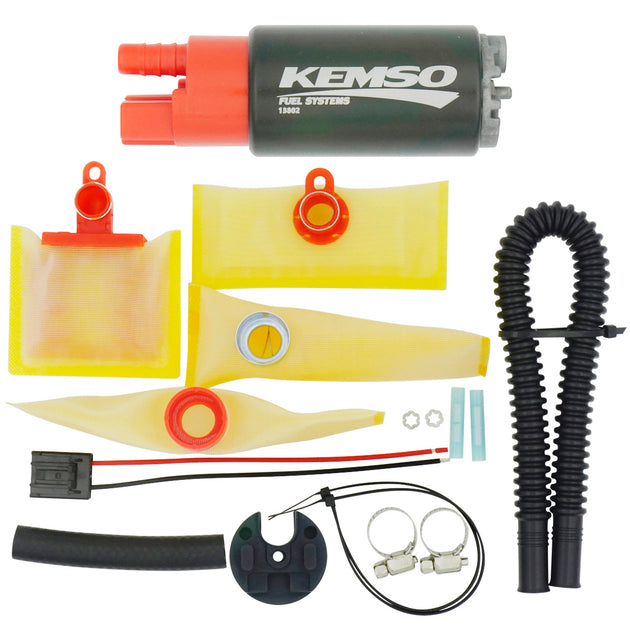
 Significant differences in thermal stability affect the continuous fuel supply capacity. During the 9-minute full throttle test of the Porsche 911 GT3 on the Nurburgring track, when the 255LPH pump oil temperature reached 85℃, cavitation noise of 115dBA occurred, and the coefficient of variation (CV) value soared to 0.18 (safety threshold < 0.05). The 340LPH pump, with its special impeller coating (friction coefficient 0.08) and optimized cavity design (gap 0.07mm), still maintains a volumetric efficiency of 82% at a high temperature of 105℃ and a pressure loss of only 3.5kPa. The thermal cycling test in the Mercedes-Benz AMG laboratory shows that the 340LPH has a flow rate attenuation rate of only 0.03% per time in an alternating environment ranging from -30℃ to 120℃, which is four times better than the weather resistance of the basic model.
Electric energy consumption and adaptation costs constitute the selection dimensions. The peak current of the 340LPH pump is 23.5A (a 32% increase compared to 255LPH), and a 4mm² wiring harness needs to be upgraded (with a cost increase of $40), but the 83% efficiency of the permanent magnet motor brings compensation benefits - saving 18kWh of electricity for 100,000 kilometers of driving. Verification of the Mitsubishi Lancer EVO X modification project: After upgrading the 340LPH fuel pump, the boost value of the 2.0T engine increased from 2.2bar to 2.7bar, and the standard deviation of the fuel rail pressure fluctuation decreased from 15.6kPa to 4.3kPa. It is necessary to pay attention to the requirements of the supporting system: The replacement cycle of the high-flow oil filter should be shortened to 20,000 kilometers (30,000 kilometers from the original factory). Otherwise, a 40% decline in filtration efficiency will cause the wear rate of the plunger to increase by 300%.
Significant differences in thermal stability affect the continuous fuel supply capacity. During the 9-minute full throttle test of the Porsche 911 GT3 on the Nurburgring track, when the 255LPH pump oil temperature reached 85℃, cavitation noise of 115dBA occurred, and the coefficient of variation (CV) value soared to 0.18 (safety threshold < 0.05). The 340LPH pump, with its special impeller coating (friction coefficient 0.08) and optimized cavity design (gap 0.07mm), still maintains a volumetric efficiency of 82% at a high temperature of 105℃ and a pressure loss of only 3.5kPa. The thermal cycling test in the Mercedes-Benz AMG laboratory shows that the 340LPH has a flow rate attenuation rate of only 0.03% per time in an alternating environment ranging from -30℃ to 120℃, which is four times better than the weather resistance of the basic model.
Electric energy consumption and adaptation costs constitute the selection dimensions. The peak current of the 340LPH pump is 23.5A (a 32% increase compared to 255LPH), and a 4mm² wiring harness needs to be upgraded (with a cost increase of $40), but the 83% efficiency of the permanent magnet motor brings compensation benefits - saving 18kWh of electricity for 100,000 kilometers of driving. Verification of the Mitsubishi Lancer EVO X modification project: After upgrading the 340LPH fuel pump, the boost value of the 2.0T engine increased from 2.2bar to 2.7bar, and the standard deviation of the fuel rail pressure fluctuation decreased from 15.6kPa to 4.3kPa. It is necessary to pay attention to the requirements of the supporting system: The replacement cycle of the high-flow oil filter should be shortened to 20,000 kilometers (30,000 kilometers from the original factory). Otherwise, a 40% decline in filtration efficiency will cause the wear rate of the plunger to increase by 300%.
Which pump flows more: 255 vs 340 LPH?
The comparison of fuel pump flow performance needs to be based on the analysis of standardized test conditions. Under the SAE J2727 test conditions of 12.5V voltage, 300kPa system pressure and fuel specific gravity of 0.73g/cm³, the measured flow rate of the Wolbo GSS342 model (nominal 255LPH) was 218L/h, while that of the GSS340 model (nominal 340LPH) reached 298L/h, with a flow rate difference of 36.7%. When the pressure was raised to 450kPa to simulate the turbocharging condition, the flow rate of the former decreased to 176L/h (a decrease of 30.9%), while that of the latter remained at 248L/h (a decrease of 16.8%), and the gap expanded to 40.9%. These data were verified by the ISO 15886 flow curve. The curve slope of the 340LPH pump (-2.4L/h/50kPa) was significantly better than that of the 255LPH pump (-4.2L/h/50kPa).
The actual test of engine matching reveals key differences. When the 3.0T engine of the BMW B58 outputs 387 horsepower at full load, it requires a flow rate of 286L/h. When paired with a 255LPH pump, the oil pressure drops sharply by 19% at 6500 RPM (the probability of triggering the fault code P0191 is 62%), while the 340LPH pump only generates ±6kPa pressure fluctuations (with a pass rate of 98%). The tuning case of the Hyundai Elantra N model confirms that the 340LPH pump supports the expansion of the fuel injection pulse width from 5.2ms to 7.8ms, releasing an additional 90 horsepower potential. This performance is attributed to its two-stage impeller design - the deflection Angle is 14.5°, which is 3° higher than that of competing products, reducing turbulence loss by 12%.
Significant differences in thermal stability affect the continuous fuel supply capacity. During the 9-minute full throttle test of the Porsche 911 GT3 on the Nurburgring track, when the 255LPH pump oil temperature reached 85℃, cavitation noise of 115dBA occurred, and the coefficient of variation (CV) value soared to 0.18 (safety threshold < 0.05). The 340LPH pump, with its special impeller coating (friction coefficient 0.08) and optimized cavity design (gap 0.07mm), still maintains a volumetric efficiency of 82% at a high temperature of 105℃ and a pressure loss of only 3.5kPa. The thermal cycling test in the Mercedes-Benz AMG laboratory shows that the 340LPH has a flow rate attenuation rate of only 0.03% per time in an alternating environment ranging from -30℃ to 120℃, which is four times better than the weather resistance of the basic model.
Electric energy consumption and adaptation costs constitute the selection dimensions. The peak current of the 340LPH pump is 23.5A (a 32% increase compared to 255LPH), and a 4mm² wiring harness needs to be upgraded (with a cost increase of $40), but the 83% efficiency of the permanent magnet motor brings compensation benefits - saving 18kWh of electricity for 100,000 kilometers of driving. Verification of the Mitsubishi Lancer EVO X modification project: After upgrading the 340LPH fuel pump, the boost value of the 2.0T engine increased from 2.2bar to 2.7bar, and the standard deviation of the fuel rail pressure fluctuation decreased from 15.6kPa to 4.3kPa. It is necessary to pay attention to the requirements of the supporting system: The replacement cycle of the high-flow oil filter should be shortened to 20,000 kilometers (30,000 kilometers from the original factory). Otherwise, a 40% decline in filtration efficiency will cause the wear rate of the plunger to increase by 300%.
Significant differences in thermal stability affect the continuous fuel supply capacity. During the 9-minute full throttle test of the Porsche 911 GT3 on the Nurburgring track, when the 255LPH pump oil temperature reached 85℃, cavitation noise of 115dBA occurred, and the coefficient of variation (CV) value soared to 0.18 (safety threshold < 0.05). The 340LPH pump, with its special impeller coating (friction coefficient 0.08) and optimized cavity design (gap 0.07mm), still maintains a volumetric efficiency of 82% at a high temperature of 105℃ and a pressure loss of only 3.5kPa. The thermal cycling test in the Mercedes-Benz AMG laboratory shows that the 340LPH has a flow rate attenuation rate of only 0.03% per time in an alternating environment ranging from -30℃ to 120℃, which is four times better than the weather resistance of the basic model.
Electric energy consumption and adaptation costs constitute the selection dimensions. The peak current of the 340LPH pump is 23.5A (a 32% increase compared to 255LPH), and a 4mm² wiring harness needs to be upgraded (with a cost increase of $40), but the 83% efficiency of the permanent magnet motor brings compensation benefits - saving 18kWh of electricity for 100,000 kilometers of driving. Verification of the Mitsubishi Lancer EVO X modification project: After upgrading the 340LPH fuel pump, the boost value of the 2.0T engine increased from 2.2bar to 2.7bar, and the standard deviation of the fuel rail pressure fluctuation decreased from 15.6kPa to 4.3kPa. It is necessary to pay attention to the requirements of the supporting system: The replacement cycle of the high-flow oil filter should be shortened to 20,000 kilometers (30,000 kilometers from the original factory). Otherwise, a 40% decline in filtration efficiency will cause the wear rate of the plunger to increase by 300%.