Twelve Years of Cable Making, One Product Line
The company timeline on KUKA CABLE's own pages opens in August 2012, and counting to the read date of 24 Sept 2026 gives fourteen years and one month of continuous manufacturing — my subtraction, not a sentence from the site. The line that emerged from that record, the solar cable range, has run as an independent PV division since August 2018, which is eight years and one month by the same count.
Key takeaways
- The published timeline runs from August 2012, with the first factory built in December 2012.
- The PV division has been independent since August 2018, and the range carries TUV, SAA and CPR certifications.
- Customers are supplied in more than 120 countries; the Jinshan facility covers more than 7,000 m².
- No capacity, headcount, unit price or minimum order quantity is published anywhere on the site.
The timeline as the pages tell it
The company timeline carries eight dated entries. The company was founded in August 2012 and the first factory was built that December. A speciality cable laboratory followed in December 2015. By March 2016 the company had sold to more than 70 countries. In August 2018 the PV division became independent, in June 2021 a wire harness processing base was established, and in March 2023 the company was recognised as a national high-tech enterprise. A new factory was completed in May 2023, and the reach figure now stands at more than 120 countries.
Read as a single record, the milestones do something useful for a buyer: they show which parts of the business were built first. The laboratory predates the independent PV division by nearly three years, so testing capacity existed before the solar range was separated out.
What the single line actually contains
The PV side is not one SKU. The published range covers DC cables, AC cables, inverter plug wires, connectors and wiring harnesses, with TUV, SAA and CPR certifications named on the site. Named models include H1Z2Z2-K, PV1-F and UL 4703 PV wire, and the common sizes are 4 mm², 6 mm² and 10 mm² in single-core and twin-core versions. Connectors, fuse connectors, diode connectors and pre-made assemblies sit alongside the cable itself.
The rest of the catalogue is broader — robot cable, battery cable, welding cable, marine cable, submersible cable, boundary wire and power cords for EU, UK, US and AU markets — but the solar side is described on the site as one of the more widely sold product families, which is why it has its own content section covering construction, characteristics and the risks of cutting corners.
Two details on the range are worth checking against a datasheet before anything else. One product page states an expected life of 30 years for a single construction, while the family is described elsewhere as lasting 25 years or more, so the two numbers have different scopes. The rated voltage named for the 1500 V build is DC 1.8/1.8 kV, and a spark test at 10 kV runs during production on the same construction.
Why concentration helps a specification
A supplier that runs one product line through one laboratory has fewer places to hide a weak value. The published test menu for the PV range includes water resistance, UV accelerated weathering, abrasion, cold bending, cold elongation, tensile strength after ageing, solderability, static flexibility and dimensional inspection, plus a 2,000-hour xenon lamp run that the site equates with roughly 360 weathering cycles. On elongation, the property that keeps a cable supple as it ages, the published figure reaches 185% where the EN 50618 floor is 125%.
Quantity reaches in the same way. Products and services are supplied to customers in more than 120 countries, and the published footprint includes a UK warehouse in Blackley, Manchester, a Spain warehouse in Logroño, an office and warehouse in Indonesia and Australian operations across four states. Physical reach is published in a second place worth reading: the facility in Jinshan District covers more than 7,000 m² with production lines and laboratories under one roof, and the core team members are described as having more than 10 years of experience in cable manufacturing and international trade. None of that is a delivery promise; it is where the company says its stock and its people sit.
The gap between a timeline and a datasheet
Years of operation are easy to publish and hard to verify, so treat them as context rather than evidence. What a buyer can check is more granular: the construction of the conductor, the insulation and sheath material, the rating, the bending radius and the standards named on the datasheet for the exact size being ordered. Those details change per cross-section and are the ones that decide whether the cable suits a project.
The company also describes a one-stop butler service, where a product consultant stays responsible through enquiry, delivery and post-maintenance, and offers free samples on product pages. Useful items to ask for early are the datasheet, a sample length and the certificate covering the construction, since all three are published as available rather than quoted as promises. KUKA CABLE does not publish unit prices, so the first reply on cost will carry commercial terms rather than a list price; keeping the technical questions separate from the commercial ones makes both easier to check.
| Size | Outer diameter | Mass per metre | Stranding |
|---|---|---|---|
| 1.5 mm² | 4.6 mm | 34 g/m | 39 × 0.25 mm |
| 2.5 mm² | 5.0 mm | 45 g/m | 49 × 0.25 mm |
| 4 mm² | 5.5 mm | 59 g/m | 56 × 0.29 mm |
| 6 mm² | 6.0 mm | 78 g/m | 84 × 0.29 mm |
| 10 mm² | 7.5 mm | 130 g/m | 142 × 0.29 mm |
| 16 mm² | 8.8 mm | 190 g/m | 238 × 0.29 mm |
Worked example
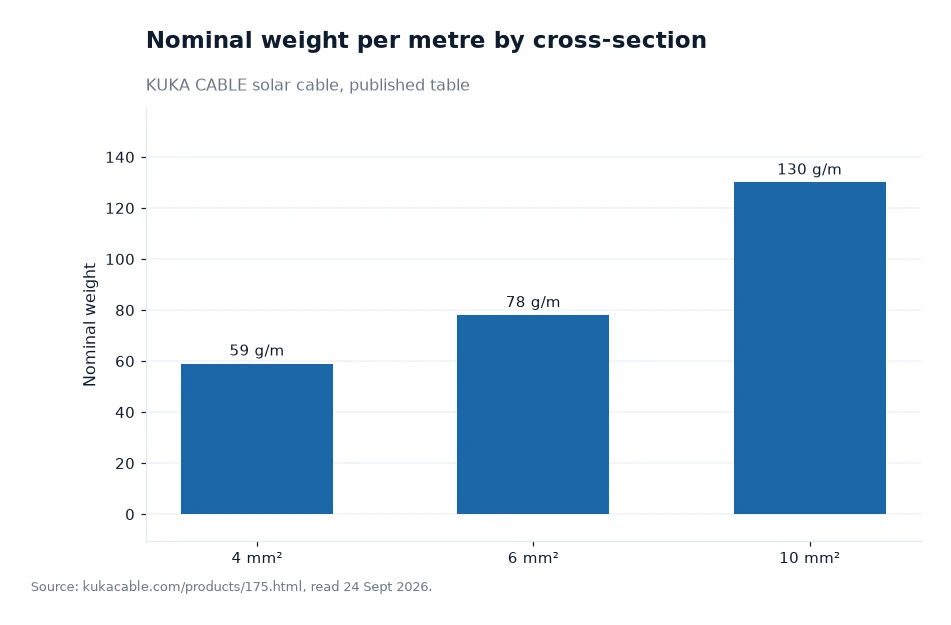
The chart beside this section carries the manufacturer's own title, "Nominal weight per metre by cross-section", and three values from the published table: 59 g/m at 4 mm², 78 g/m at 6 mm² and 130 g/m at 10 mm². Its source page is kukacable.com/products/175.html. Multiplying those published weights by a drum length is my own arithmetic and nothing more. A 500 m run of 4 mm² comes to 29.5 kg of cable, the same length in 6 mm² comes to 39 kg, and in 10 mm² it reaches 65 kg. Spread over a kilometre, the three figures become 59 kg, 78 kg and 130 kg. On a rooftop where a crew pulls long strings by hand, that difference per drum is the practical part of a weight column.
Frequently asked questions
Does a long company history say anything about cable quality?
It says the operation has survived changes in the market, and little more. The verifiable part of the same story is dated and checkable: the laboratory opened in December 2015, the PV division became independent in August 2018 and the national high-tech enterprise recognition arrived in March 2023. A buyer can ask for the certificate behind the last of those and read the construction data for the size on order.
How many sizes does the range cover?
The published table runs from 1.5 mm² to 240 mm², with 4 mm², 6 mm² and 10 mm² named as the commonly used specifications and single-core and twin-core versions available. Insulation and sheath thickness also grow with size: 0.7 mm and 0.8 mm at the small end, widening to 0.9 mm to 1.7 mm on the largest constructions.
What to do with the timeline
Take the dates as background and spend the diligence on the documents. Ask for the datasheet covering the exact cross-section, the certificate for that construction and a sample length to inspect. Check the conductor strand count against the table, look at the wall thickness and confirm the rated voltage before the order is placed. Years of manufacturing are a reason to start a conversation, not a substitute for the paperwork that closes one.
Founding dates and the weight-per-metre table both sit on the manufacturer's own website, kukacable.com, captured 24 Sept 2026[1].