Using Trend Data to Pick Your Next Chat
Trend data answers one question well - what has been popular recently - and one badly: whether it suits you. A weekly list of 20 NSFW AI characters, refreshed every Thursday, is a starting point rather than a verdict. The method below turns it into a decision in three passes, and if one browsing session in three is spent looking rather than talking, a 28-session run costs about 93 minutes of looking.

Key takeaways
- Three passes: filter first, then read two descriptions, then check one counter. Anything more is browsing rather than deciding.
- The charts refresh on Thursdays, so a Monday choice is made against data that is at most six days old - enough for a weekly habit, not for a daily one.
- Use the keep rate as a tie-breaker, not a ranking: three card readings came out at 0.029%, 0.026% and 0.015%.
- Cap the browsing half of a session. On a 28-session ramp, one third of a ten-minute session spent looking is 93 minutes over six weeks.
What trend data can and cannot tell you
Trend data is a measurement of attention. Views record how many readers were served a card and opened it; favourites record how many decided to keep it. Both are cumulative and both respond to placement, which is why a ranked list is better read as a description of a week's traffic than of a week's quality.
What the list does well is answer the coldest question in the whole process: where do I start? Twenty entries with tags and a creator credit is a far better first move than a blank search box, and a weekly refresh means the list stays useful without you maintaining it. What it cannot do is tell you whether a described personality will land for you, because that depends on the writing rather than the counters.
There is also a useful side effect of a weekly rhythm. Because the rankings update every Thursday and the shelf holds twenty cards, the list tends to change slowly. That is a feature: if you choose on Thursday and return a week later, most of the shelf is the same, so any decision you made is still comparable. A list that churned hourly would be a worse tool for planning.
The three-pass decision
Pass one is filtering. The platform offers Filtered, Unfiltered and 18+ views, and the tags on a card include things like Unfiltered, Submissive, Fictional, OC and Female. Decide which of those you want before you look at any ranking, because the ranking is only meaningful inside the pool you chose.
Pass two is two descriptions. Read two cards properly, all the way through, rather than skimming eight. The test is whether the description tells you how the character behaves in a second message; if it does, the card has done its job. Two is enough because the first two candidates on a shelf usually share most of their tags, and comparing more of the same tags adds noise rather than information.
Pass three is one counter, used as a tie-break. Divide favourites by views and compare. Keep rates across three card readings came to 0.029%, 0.026% and about 0.015%, which is a twofold spread in how much of an audience kept the card. If your two candidates have similar descriptions, the higher rate is the better bet; if the descriptions differ in quality, ignore the counters entirely.
| Pass | Time it takes | What it decides | The mistake it prevents |
|---|---|---|---|
| Filter selection | Under a minute | Which pool the ranking is drawn from | Judging the platform on a shelf you did not intend to browse |
| Two descriptions read | Three to four minutes | Whether the card's behaviour is predictable | Trial-and-error spent on cards that never described themselves |
| One keep-rate comparison | One minute | Which of two similar cards to open first | Choosing on view totals, which mostly report placement |
| The first session | Ten to fifteen minutes | Whether to keep the card | Keeping a card out of politeness rather than interest |
Worked example: capping the browsing half of a habit
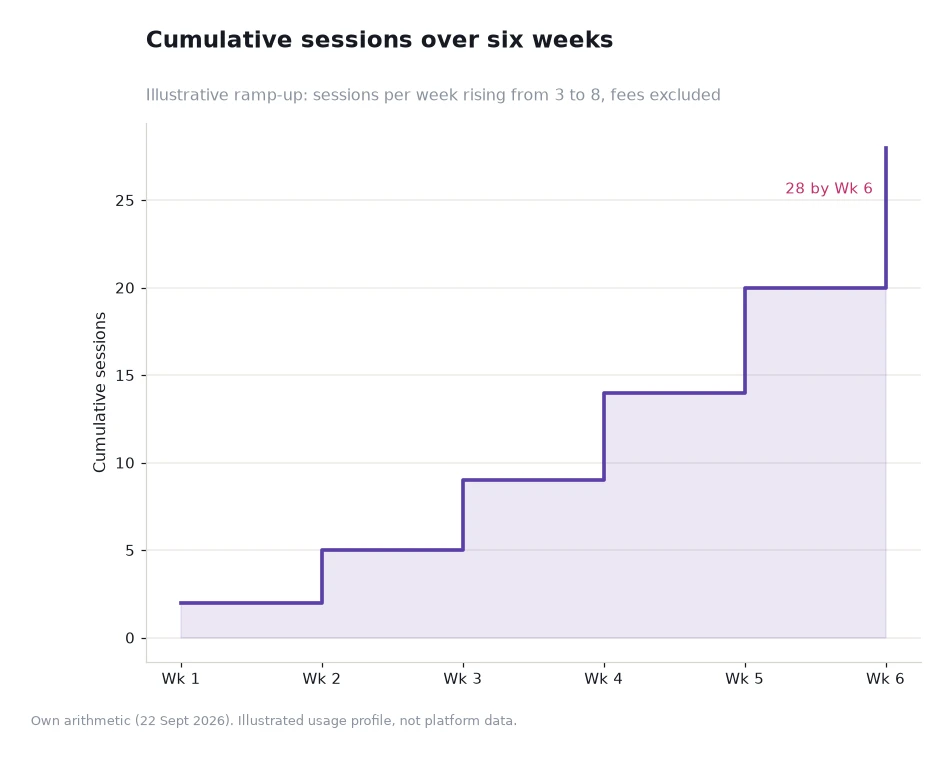
Take the ramp below, which is illustrative arithmetic: weekly sessions of 2, 3, 4, 5, 6 and 8, which accumulate to 28 sessions over six weeks, an average of 4.7 a week. At ten minutes a session that is 280 minutes, or 4.7 hours across the period.
Now split that time. The three-pass method above takes about five minutes if you read two descriptions and check one ratio, so two sessions in three can be pure conversation and one in three will be a browsing session. A third of 280 minutes is 93 minutes - an hour and a half of browsing across six weeks, which is a reasonable price. Two thirds is 187 minutes, or about three hours, spent actually talking.
Push the browsing share to half and the same six weeks cost 140 minutes of looking, an extra 47 minutes for no additional conversations. That is the argument for the cap: decide in five minutes and start the session, or accept that you have chosen to browse and count it as the activity it is. The chart figures are assumptions built to show the split, not platform data.
Working the Thursday rhythm
Choose on Thursday or Friday, once a week, and hold the decision until the next refresh. There are two reasons. The first is that the list is stable over that window, so your comparison stays valid. The second is that a weekly cadence matches how a shelf behaves: nothing in a seven-day ranking changes fast enough to justify checking twice a day, and checking daily turns a decision aid into a feed.
Use the right page for the right job. The nsfw ai chat shelf is where the twenty cards and their counters appear, which makes it the best place for pass two and pass three. The character search page is better when you already know the tags you want and do not need a ranking at all, and the weekly rankings give the same information ordered for a weekly habit rather than a browsing session.
One last piece of discipline: write down the decision and the reason in a single line. "Thursday, chose card B, description mentioned behaviour in the second message" is enough. Six of those lines is a record of what actually works for you, which is a far better guide than the ranking itself will ever be.
Frequently asked questions
Should I pick the top card on the ranking?
No. Position reflects a week's traffic and placement. Use the ranking to choose a pool, then decide on the description and one keep-rate comparison.
How often should I check the trend list?
Weekly is enough, ideally just after the Thursday refresh. The shelf changes slowly enough that more frequent checks add browsing time rather than information.
What does a keep rate tell me that views do not?
How much of an audience chose to keep a card. Three readings came out at 0.029%, 0.026% and 0.015%, a twofold spread that view totals of 18.2M to 24.3M hide.
Decide in five minutes, then talk
Run the three passes in order on Thursday, write one line about the choice, and cap the browsing half of any session at five minutes once you have a shortlist. If you are still comparing after ten minutes, close the shelf and come back next week, because the list will barely have moved. The point of trend data is to shorten the search, not to become the activity - and a 93-minute browsing budget across six weeks is generous, provided the other 187 minutes belong to conversations.
Data: trending shelf counters, tag labels and the Thursday refresh cadence as published by Crushon, read 22 Sept 2026[1]. Session and time-split figures are own arithmetic presented as an illustrative profile, not platform data. For adults only; the platform is intended for readers aged 18 and above.